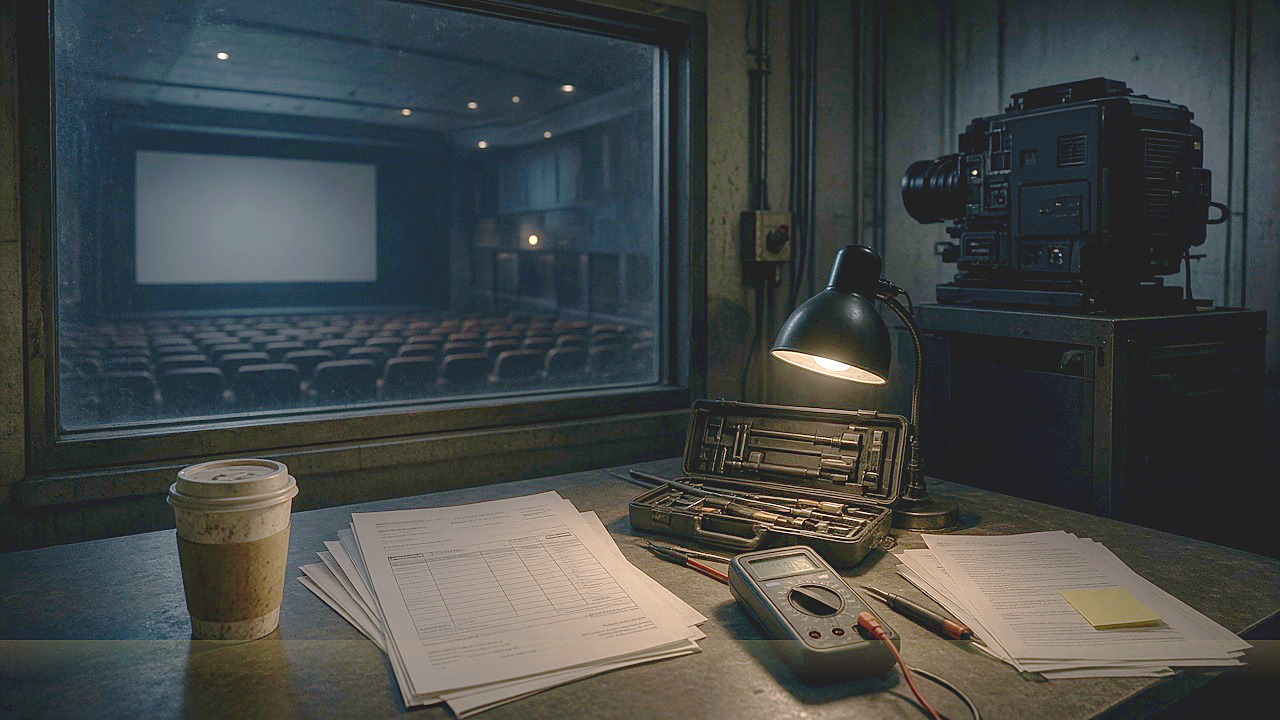
I have spent more than forty years in this industry — living in projection booths, crawling behind the screen, answering dark-screen calls at hours when most people are asleep. Before digital, the booth was not just where the movie ran. It was where we grew technicians.
We fired that seat.
Not with a pink slip served on a platter — though that would have been honest, in a booth sort of way. We stopped staffing the booth as a dedicated job once the digital projector could run without a full-time operator. Many houses no longer staff a dedicated projectionist or booth technician. Shows still run. Alarms still page. But the path into the trade — years in the booth, then into field service — got thinner.
So the question for exhibition is not nostalgic. It is operational:
Now where do we get the booth technician?
We removed the apprentice seat. We still need booth and field techs. We have to staff the learning route on purpose.
What the seat taught
That seat taught film path and lamp house, changeovers and platter quirks, how a theater smelled when something was wrong before the audience noticed. A full-time projectionist was the junior tech on the property — an apprenticeship with a paycheck and a schedule nobody outside exhibition would choose on purpose. Nights, weekends, holidays — because that is when cinema works, and nobody books a matinee for a dark-screen emergency. Friday night, sold-out auditorium, screen goes dark: you learned who to call and what not to touch. You also learned the boring craft that never makes a brochure — splicing under pressure, lamp changes that do not burn a print, logging what failed so the next shift is not guessing. The good ones fed the service pool. Dealers, manufacturers, regional techs — the people who could walk into a multiplex and actually fix something — a lot of us started there. Remove the seat, and you still need the craft. You just stopped growing it on property.
Cinema service lives on nights, weekends, holidays, and the phone call that starts with “we’re dark.” Audiences do not wait for Monday morning. Circuits do not either. That schedule already filters the applicant pool. After digital conversion, the pipeline got scarcer still — field observation, not a census.
EQ and align vs. swap-and-pray
There are techs who can EQ and align a room with judgment, chase a ground loop, read a TMS log, and leave the auditorium better than they found it. And there are people who swap the box, reboot the rack, and pray the picture comes back — swap-and-pray, the unofficial religion of the understaffed show night. Both can keep a show night moving in a pinch. Only one builds the network this industry needs when the easy problem is gone and the hard one is still broken at 11:40 p.m. — sold-out house, manager on the headset sounding calmer than the room, and nobody on the property who has lived with that rack long enough to know what “normal” sounded like last week.
EQ and align with judgment — or swap the box, reboot the rack, and pray. Only one builds the network this industry needs at 11:40 p.m.
I am not blaming digital projectors for that gap. We removed the place where the better kind of technician used to learn under load, for years. Dropping the entry role does not eliminate the need for seniors. It postpones the bill until the experienced people retire, burn out, or stop answering holiday pages.
A different machine, same gap
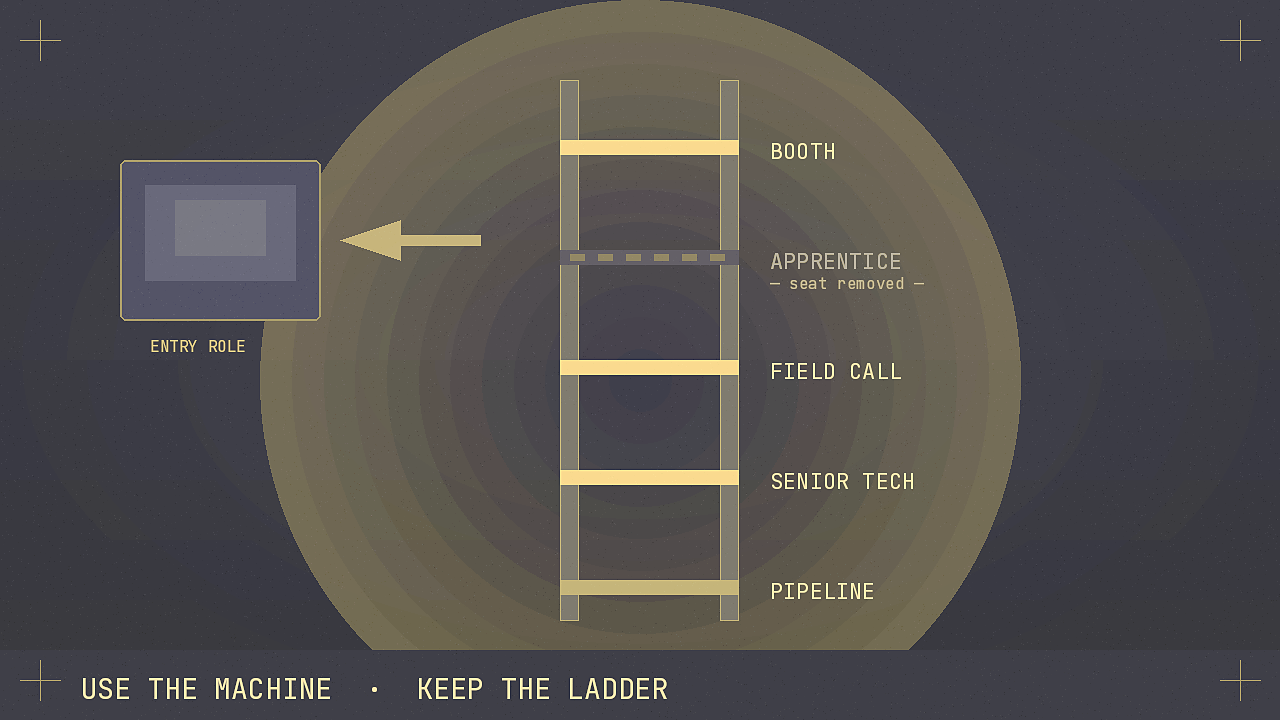
Writers’ rooms and junior accounting floors are learning a rhyming lesson. Generative AI eats the training tasks first — first drafts, reconciliations, boilerplate — the work that used to teach the next person in line. Stanford’s Digital Economy Lab: hiring slowed for young workers in highly AI-exposed jobs, ages 22–25 roughly 19% below less-exposed peers, mostly through reduced hiring rather than mass layoffs. The useful language is still exposure and task share, not a cartoon body count — seniors with tacit knowledge often look complementary while the associate seat thins. Hollywood’s writers, in 2023, fought for terms rather than smashing the cameras.
Exhibition did not need a chatbot to remove an entry-level technical role. We removed the booth seat. Same gap, different machine: the productivity story sounds clean on a slide labeled “progress.” The pipeline story does not.
Ask a hard staffing question in this business and someone will eventually call you a Luddite — as if wanting a trained kid on the dark-screen call were the same as fearing electricity. History is less cinematic. The name comes from Ned Ludd, a legendary (likely mythic) stocking-frame breaker said to have smashed a frame around 1779 after a rebuke; by 1811–1816, Midlands textile workers adopted “Ludd” as a banner for real protests. They were skilled operators — framework knitters, croppers, weavers — fighting wage cuts, deskilling, and shoddy goods when owners took the productivity gain and hollowed the apprenticeship. They often spared shops that paid customary rates. Eric Hobsbawm later called the tactic “collective bargaining by riot.” Fair terms meant rates and a path to craft mastery — not a ban on frames. I am not swinging a crowbar at the digital projector. I am asking who trains the kid who answers when the screen goes dark. That is not technophobia. That is stewardship.
To be sure
Critics may argue that digital made dedicated projectionists unnecessary — that automation is progress, and worrying about the old seat is Luddite fear of tech. The conversion was necessary. I am not writing a romance novel about 35mm. Tools change. The flaw is not the machine. The flaw is deleting the learning route without replacing it.
What to do
Staff the learning route on purpose.
If you no longer staff a full-time projectionist, name the replacement: paid trainee hours, ride-alongs with field service, shadow time on installs and dark-screen calls — not leftover scraps and a job board that filters for cinema hours nobody would pick for the lifestyle.
Prefer EQ-and-align over swap-and-pray — and pay for the difference. Hire and promote for measurement, judgment, and documentation. A reboot that restores the show is a bandage. A technician who leaves the room aligned is infrastructure.
Use the new tools; do not erase the role. AI for booth docs, TMS triage, remote alerts — fine, with a named human owner. Automation that pages a ghost pipeline is not efficiency.
Measure succession, not only cost per call. Faster garbage still costs you Friday night. A thin bench costs you the decade after that.
Use the machine. Keep the ladder.
If those are not the same decision, we did not finish the conversion. We only cut the junior seat and hoped the seniors would last forever — then wondered, a few years later, why nobody answers the dark-screen call.