In This Article
- The Rule Everyone Knows — And Why It Tricks Us
- Multiple Bands: Where the Math Gets Ugly
- Why You Can't Just Buy More Power
- The Physics of Clipping: Creating Energy That Was Never There
- The Psychoacoustics: The Fletcher-Munson Trap
- The "Sounds Loud But Is Distorted" Phenomenon
- The Full Distortion Chain
- The Hall of Shame: A Real-World Bad EQ
- Practical Rules for Cinema EQ
I have been in cinema audio for over 40 years. I have walked into more equipment rooms than I can count, and I have seen things on 31-band equalizers that would make a re-recording mixer weep into their Pro Tools session. Sliders pushed up like a city skyline. A heroic +4 dB at 3.15 kHz sitting next to a +3.5 dB at 2.5 kHz, presumably because someone decided the dialogue needed more "presence"— and then kept going. I call this the Manhattan Skyline EQ setting, and it is destroying your headroom, your amplifiers, and your audience's experience, one transient at a time.
I have also heard the complaint a thousand times from cinema managers: "The movie is too loud." They tell you the audience is complaining. They tell you it's harsh. It hurts their ears. So they walk into the booth and pull the master fader down from 7.0 to 5.5. Now the dialogue is too quiet to understand, but the explosions still sound harsh and fatiguing. The problem wasn't solved; it was just relocated.
Here is the truth that separates system designers from knob-turners: When a cinema system sounds "too loud" or "harsh" at an 85 dB reference level, it is almost never a volume problem. It is a distortion problem caused by poor EQ practices.
So let me be direct: stop boosting EQ bands in a professional cinema sound system. Not "try to avoid it." Not "use it sparingly." Stop. Put the slider down. Back away from the rack. I am going to explain exactly why — with math, with charts, and with the psychoacoustics of human hearing — that innocent-looking EQ setting is destroying your system and fatiguing your audience.
"The moment you boost a band on a 31-band EQ, you are not improving your sound. You are spending money you don't have from an account called headroom — and the bank charges interest."
— Mark F. Collins, Collins Theatre Systems LLC1. The Rule Everyone Knows — And Why It Tricks Us
Every audio professional learns early that increasing the overall sound pressure level (SPL) by 3 dB requires doubling the amplifier's power output. It is one of the foundational rules of audio physics, rooted in the logarithmic nature of the decibel scale. If your amplifier is delivering 100 watts to achieve a given SPL, you need 200 watts to get 3 dB more. You need 400 watts for 6 dB more. You need 1,000 watts for 10 dB more. The numbers escalate fast.
What is not as well understood is what happens when you apply that same 3 dB boost to a single band on a 31-band graphic equalizer. A 31-band EQ is a 1/3-octave device. Each band spans a frequency ratio of approximately 1.26:1 (the cube root of 2) — a narrow slice of the full audio spectrum. The 500 Hz band, for example, covers approximately 445 Hz to 561 Hz. That is a small fraction of the 20 Hz–20 kHz audio spectrum.
When you boost the 500 Hz band by 3 dB, the power required to reproduce that specific band does double. But here is the key: in a pink noise signal — which is what we use for cinema calibration — that band represents only about 1/30th of the total broadband energy. If your amplifier is delivering 100 watts of broadband pink noise, the 500 Hz band accounts for roughly 3.3 watts of that total. Doubling it adds only 3.3 watts to the total load — a 3.3% increase. The amplifier barely notices. You do not need a bigger amp.
A single 1/3-octave band boost of +3 dB increases the amplifier's average thermal power output by only about 3%. This is why the system sounds fine during calibration with pink noise — the average power demand is trivially small. The real danger is not power. It is headroom.
So if the power demand is negligible, what is the problem? The problem is headroom — and specifically, peak voltage headroom. Audio signals are not steady-state sine waves. They are complex, highly transient waveforms with enormous crest factors — the difference between the average level and the instantaneous peak. In a cinema mix, that crest factor can be 15 to 20 dB or more. The amplifier must be capable of delivering those voltage peaks cleanly, without clipping, even when the average power demand is low.
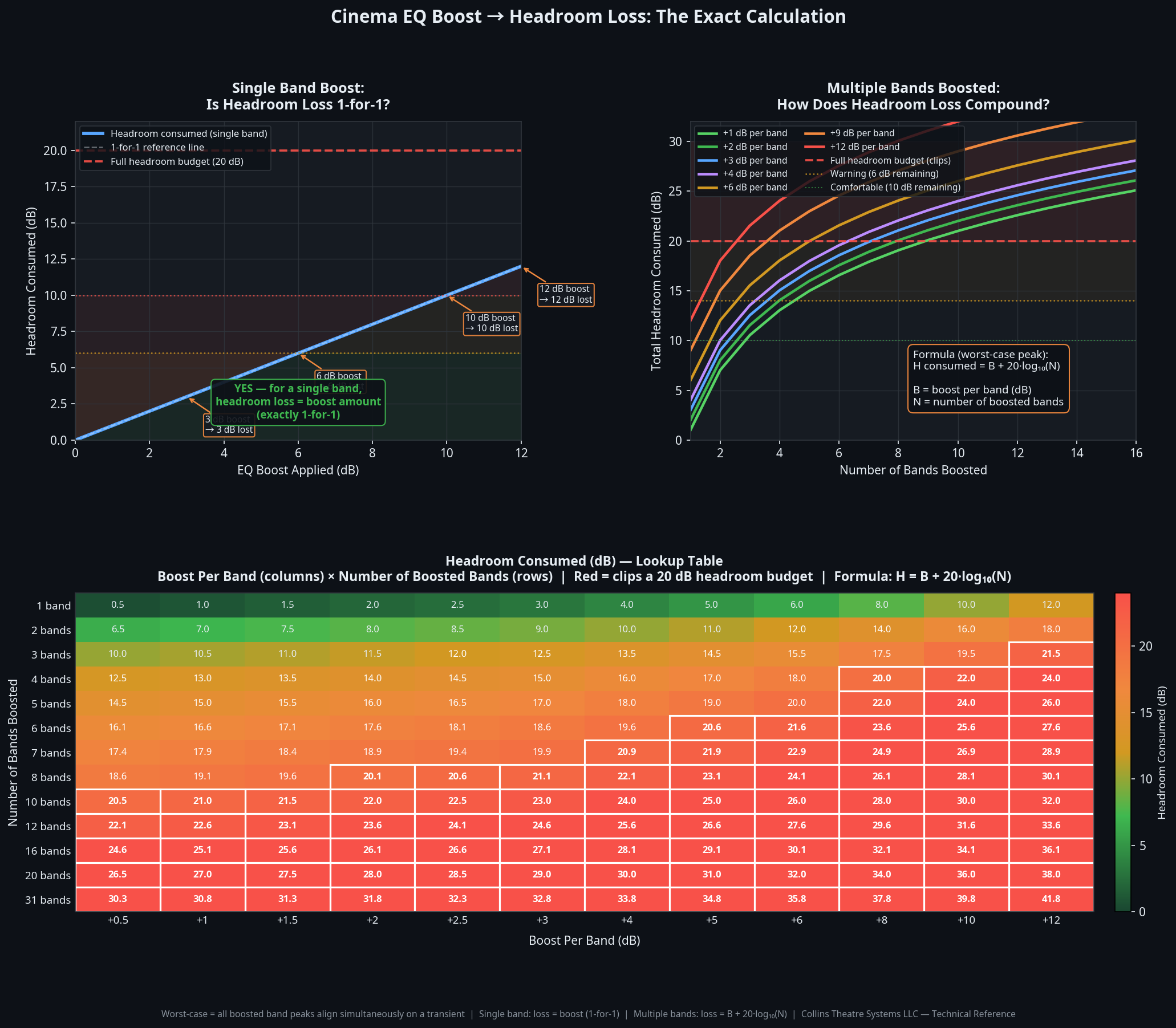
When you boost a band by 3 dB, you increase the peak voltage of that band's signal by a factor of √2 (approximately 1.414). The amplifier must now swing that higher voltage on every transient that contains energy in that frequency range. For a single band, the headroom consumed is exactly equal to the boost applied — 1 dB of boost costs exactly 1 dB of headroom. No more, no less. It is a perfect 1-for-1 trade.
Example: +3 dB boost → 3 dB of headroom consumed
Example: +6 dB boost → 6 dB of headroom consumed
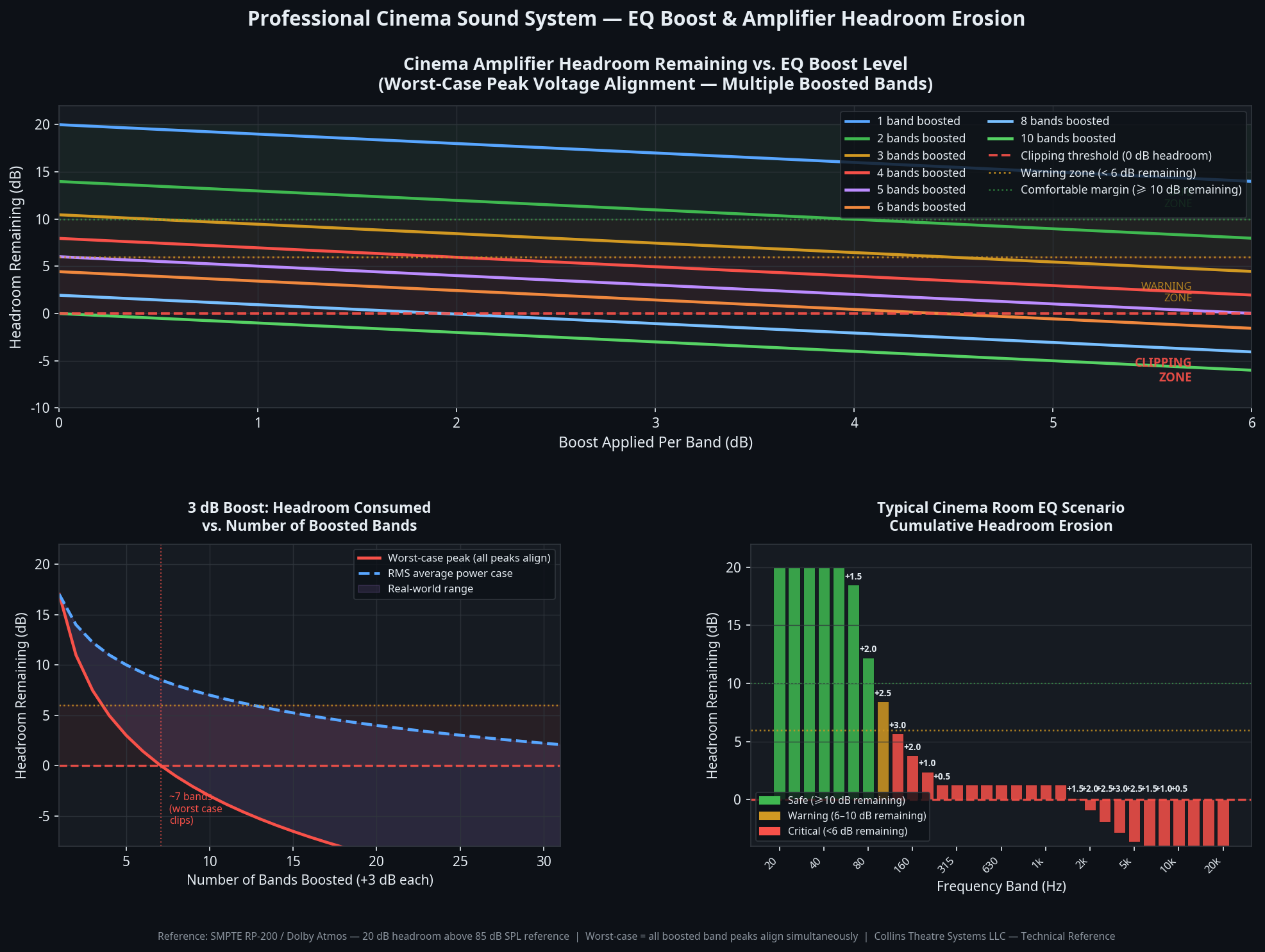
In a properly calibrated cinema system per SMPTE RP-200 and Dolby Atmos specifications, you have 20 dB of headroom above the 85 dB SPL reference level. A single +3 dB boost leaves you with 17 dB. Uncomfortable, but survivable. The real danger begins when you start stacking boosts across multiple bands.
2. Multiple Bands: Where the Math Gets Ugly
When you boost multiple bands, the worst-case scenario is that all of those boosted bands produce their peak voltages simultaneously — which happens on sharp, broadband transients in a film mix, like a gunshot, an explosion, or a door slam. In that moment, the amplifier sees the sum of all those boosted voltage peaks at once. Voltages add linearly, not logarithmically. So the total headroom consumed by N bands each boosted by B dB is not simply N × B. It is governed by this formula:
B = boost per band (dB) | N = number of boosted bands
Example: 4 bands at +3 dB → 3 + 20·log₁₀(4) = 3 + 12 = 15 dB consumed
Example: 8 bands at +3 dB → 3 + 20·log₁₀(8) = 3 + 18 = 21 dB consumed → CLIPPING
Notice what that means: boosting just 8 bands at a modest +3 dB each will clip a properly calibrated cinema system on worst-case transients. And boosting 4 bands at +3 dB each leaves you with only 5 dB of headroom — barely enough margin for a moderately loud motion picture, let alone a Marvel action sequence.
| Bands Boosted (N) | Extra Penalty (20·log₁₀N) | +3 dB Each → Total Consumed | Headroom Remaining (from 20 dB) | Status |
|---|---|---|---|---|
| 1 | 0 dB | 3.0 dB | 17.0 dB | Safe |
| 2 | +6 dB | 9.0 dB | 11.0 dB | Safe |
| 3 | +9.5 dB | 12.5 dB | 7.5 dB | Warning |
| 4 | +12 dB | 15.0 dB | 5.0 dB | Danger |
| 5 | +14 dB | 17.0 dB | 3.0 dB | Critical |
| 6 | +15.6 dB | 18.6 dB | 1.4 dB | Critical |
| 7 | +16.9 dB | 19.9 dB | 0.1 dB | Essentially Clipping |
| 8 | +18 dB | 21.0 dB | −1.0 dB | Clipping |
| 10 | +20 dB | 23.0 dB | −3.0 dB | Clipping |
3. Why You Can't Just Buy More Power
At this point, a reasonable person might ask: "If the problem is running out of amplifier headroom, why not just buy bigger amplifiers?" It is a logical question, but it hits a brick wall in the real world due to two hard constraints: the exponential cost of power and the physical limits of cinema loudspeakers.
The Exponential Cost of Headroom
To gain just 3 dB of headroom across the board, you have to double your amplifier power. If you are currently running 1,000-watt amplifiers for your screen channels to meet the SMPTE 20 dB headroom specification, upgrading to gain 3 dB more headroom requires 2,000-watt amplifiers. To gain 6 dB, you need 4,000-watt amplifiers per channel. To recover the 9.8 dB of headroom that the Manhattan Skyline EQ example destroys, you would need to nearly 10× your amplifier power — and spend accordingly.
The cost curve for professional cinema amplifiers (like the Crown DSi series or QSC DCA series) goes vertical very quickly once you pass the 1,500-watt mark. You are spending thousands of dollars per channel just to buy back the headroom you threw away for free with an EQ slider. And that is before you account for the additional heat load, rack space, and power infrastructure required for those larger amplifiers.
Recovering 9.8 dB of lost headroom through amplifier upgrades alone would require nearly 10× the original amplifier power. In a typical cinema with 5–7 screen channels, that is a five-figure equipment investment — to fix a problem that costs nothing to prevent by simply not boosting the EQ.
The Physical Limits of Loudspeakers
Even if you had an unlimited budget for 5,000-watt amplifiers, the speakers themselves cannot handle it. Professional cinema loudspeakers — like the JBL 4732, the QSC SC-423C, or the Dolby-approved screen channel systems — are highly efficient (typically 97–100 dB/1W/1m), but they have absolute physical limits that no amount of amplifier power can overcome.
When you push massive amounts of power into a voice coil to reproduce those boosted peaks, two things happen. First, thermal compression sets in: the voice coil heats up, its electrical resistance increases, and it draws less power from the amplifier, producing less acoustic output than expected. You pump in 3 dB more power, but the speaker may only give you 1 dB more output — the rest is turned into heat. Second, the speaker cone hits its mechanical excursion limit — the cone can only travel so far before the suspension bottoms out or the voice coil jumps the gap. At that point, you are no longer making more sound; you are making more distortion and potentially destroying the driver.
The 20 dB headroom budget specified by SMPTE RP-200 exists precisely because it represents the practical limit of what a properly designed cinema amplifier and speaker system can cleanly reproduce together. It is not an arbitrary number. It is the ceiling of the physical system. You cannot EQ your way past the laws of physics — and you cannot buy your way past them cheaply.
4. The Physics of Clipping: Creating Energy That Was Never There
So what happens when you boost the EQ, eat up your 20 dB of headroom, and hit the amplifier's limits? The amplifier clips. When you run out of headroom and a loud transient hits — a gunshot, a door slam, a John Williams brass swell — the amplifier cannot reproduce the peak of the waveform. It simply squares off the top and bottom. This is hard clipping.
But clipping doesn't just flatten the wave. It fundamentally alters the frequency content of the signal. A square wave is mathematically equivalent to a fundamental sine wave plus an infinite series of odd-order harmonics. When a cinema amplifier clips a 500 Hz signal, it doesn't just play a distorted 500 Hz tone. It actually generates entirely new acoustic energy at 1.5 kHz (3rd harmonic), 2.5 kHz (5th harmonic), 3.5 kHz (7th harmonic), and so on.
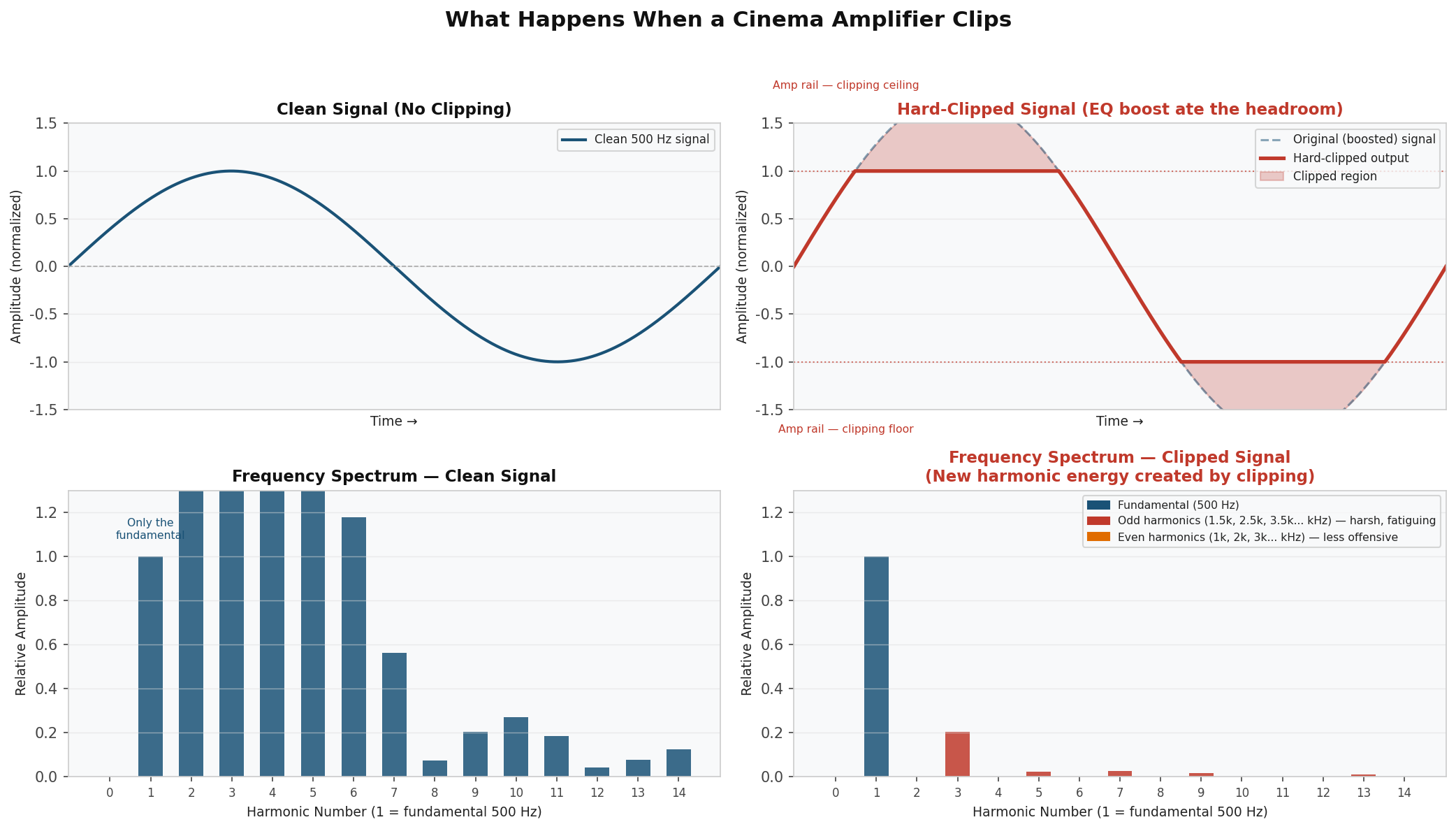
The re-recording mixer never put that energy at 2.5 kHz or 3.5 kHz into the soundtrack. The amplifier manufactured it out of thin air because it ran out of voltage. You are now blasting high-frequency distortion into the room that the filmmaker never intended.
5. The Psychoacoustics: The Fletcher-Munson Trap
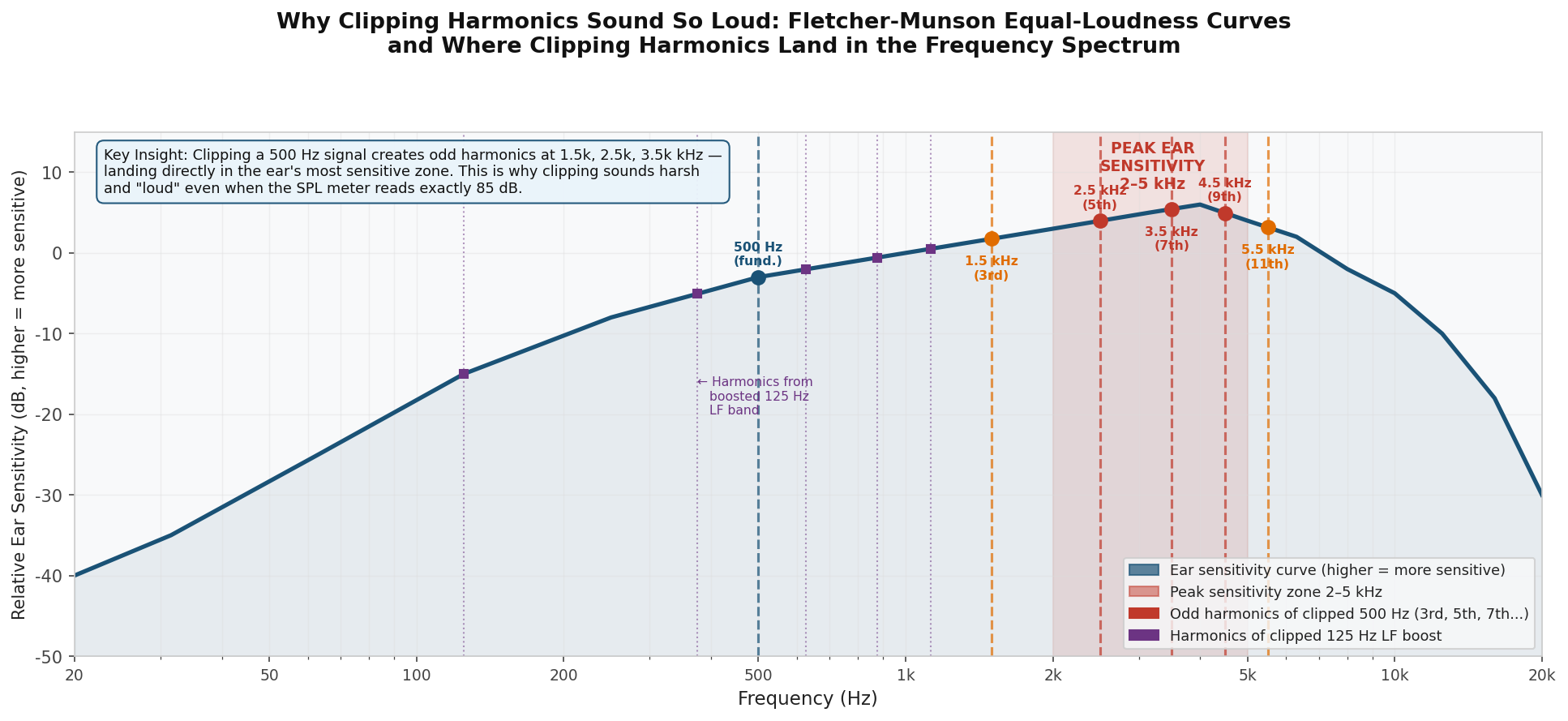
This is where human biology turns an electrical problem into an audience complaint. The human ear does not hear all frequencies equally. As described by the Fletcher-Munson equal-loudness contours, our hearing is vastly more sensitive to frequencies in the 2 kHz to 5 kHz range. This is an evolutionary adaptation optimized for understanding human speech — and hearing a twig snap in the woods before something eats you.
When low or mid-frequency sounds clip in a cinema system, the odd-order harmonics they generate land directly in this hyper-sensitive 2–5 kHz zone. Because the ear is so sensitive to these frequencies, even a small amount of harmonic distortion sounds disproportionately loud and piercing. The brain interprets this sudden blast of high-frequency energy as harshness, aggression, and extreme volume.
6. The "Sounds Loud But Is Distorted" Phenomenon
This psychoacoustic effect explains the classic cinema calibration trap. During calibration, the technician uses pink noise. Pink noise has a low crest factor and does not clip the amplifiers, so the system measures a perfect 85 dB SPL on the meter. The technician pats himself on the back and goes to lunch.
Then the movie starts. A loud transient hits the EQ-boosted system. The amplifier clips, generating a spray of high-frequency harmonic distortion. The SPL meter might still read 85 dB (or close to it), because the total acoustic power hasn't increased much. But the perceived loudness spikes dramatically because that energy has been shifted into the ear's most sensitive frequency band.
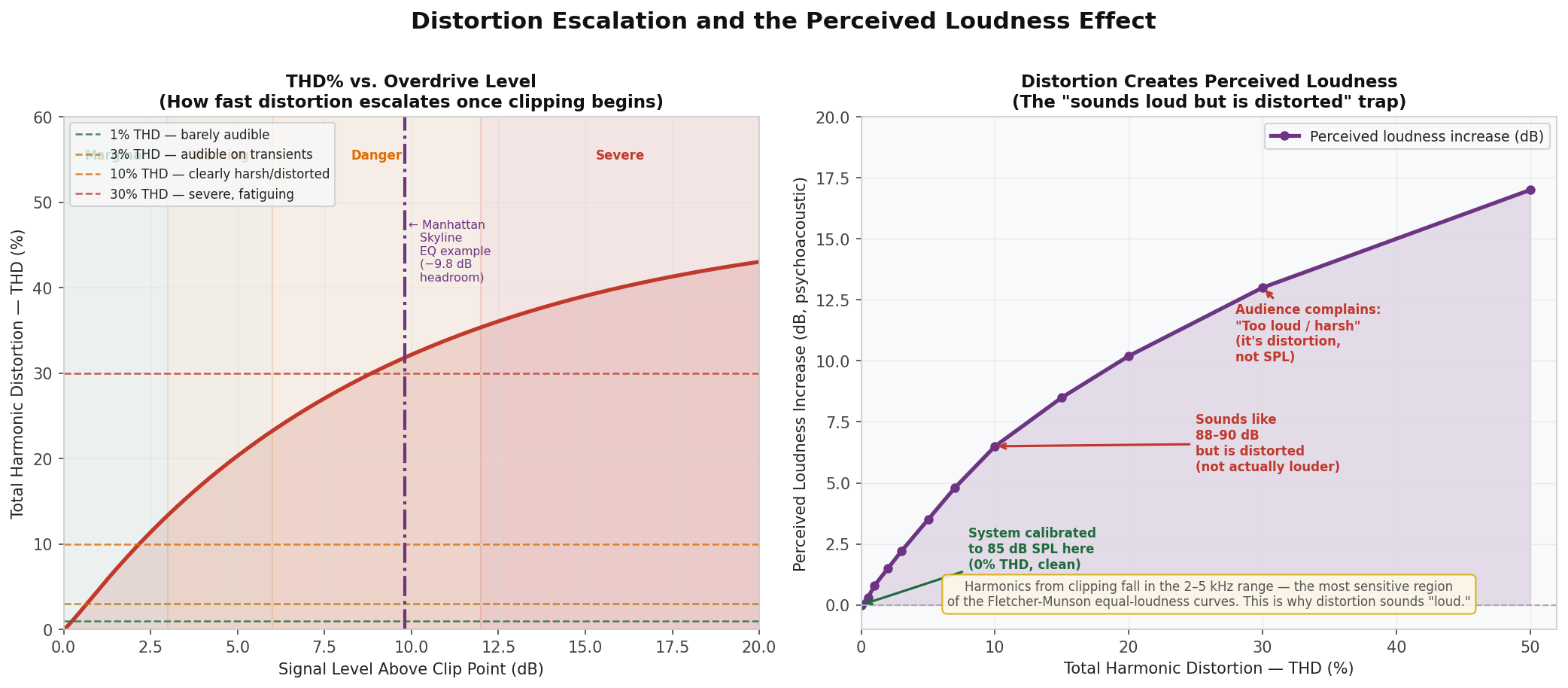
The audience complains. The manager turns the fader down. The system is still clipping on peaks — it's just clipping at a lower overall volume. The harshness remains. The manager turns it down again. Now the dialogue is unintelligible. The audience still complains. Nobody wins.
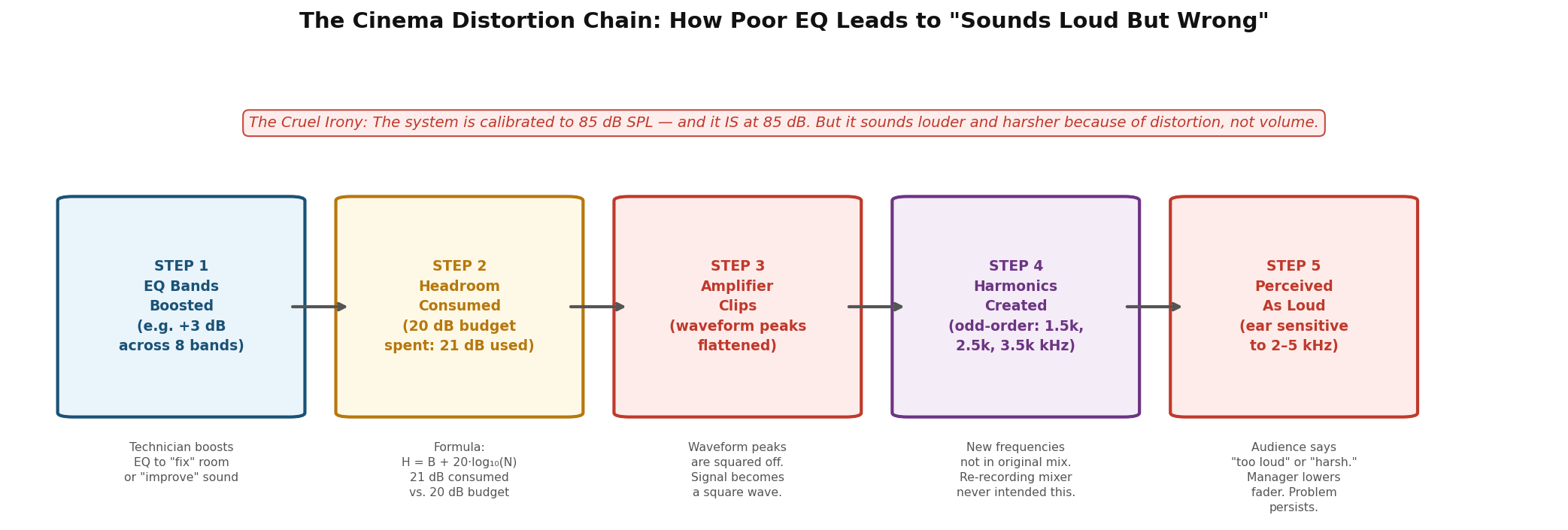
The system is calibrated to 85 dB SPL — and it is at 85 dB. But it sounds louder and harsher because of distortion, not volume. Turning the fader down treats the symptom, not the cause. The only real fix is to eliminate the EQ boosts that are consuming the headroom.
7. The Full Distortion Chain
This entire failure cascade starts with the 31-band EQ. The moment a technician decides to boost frequencies to "fix" the room, they set this chain in motion:
8. The Hall of Shame: A Real-World Bad EQ
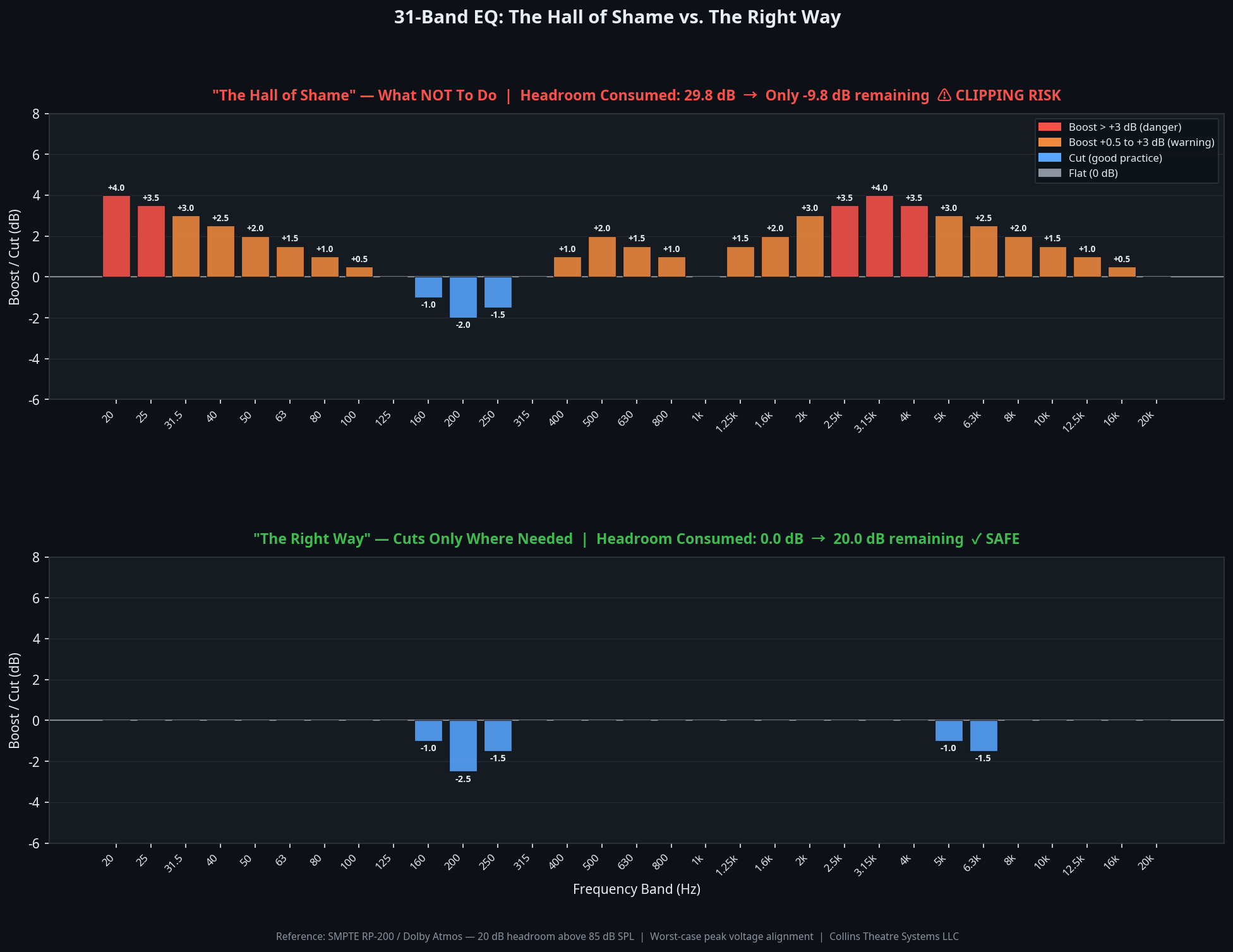
Let me show you what I am talking about. The following is a composite of EQ settings I have actually encountered in cinema equipment rooms over the years — names changed to protect the guilty, but the sliders are real. I call it the Manhattan Skyline, and it is a masterclass in well-intentioned destruction.
The technician who set this up was not malicious. They were trying to help. The low end felt a little thin, so they added some sub punch below 50 Hz. The dialogue sounded a bit muddy, so they cut the 200 Hz range — good so far. Then they decided the midrange needed "warmth" and boosted 500 Hz. Then the presence range needed "intelligibility" and up went 2 kHz through 4 kHz. Then the top end needed "air and detail," so the 6–10 kHz range got a lift too. The result is a system that measures 85 dB SPL on pink noise and sounds like a dentist's drill during a film's loudest moments.
| Frequency | Setting | Technician's Reasoning | Actual Effect |
|---|---|---|---|
| 31.5 Hz | +4 dB | "More sub impact" | 4 dB headroom consumed |
| 63 Hz | +3 dB | "More bass punch" | Adds to LF peak voltage |
| 125 Hz | +2 dB | "Warmth" | Compounds LF peaks |
| 250 Hz | −3 dB | "Cut the mud" | Good — saves headroom |
| 500 Hz | +2 dB | "Midrange body" | Begins mid boost stack |
| 1 kHz | 0 dB | — | Neutral |
| 2 kHz | +3 dB | "Dialogue presence" | Harmonics land at 4–6 kHz |
| 3.15 kHz | +4 dB | "More intelligibility" | Directly in ear's peak zone |
| 4 kHz | +3 dB | "Clarity" | Stacks on 3.15 kHz boost |
| 6.3 kHz | +2 dB | "Air" | HF energy added |
| 8 kHz | +2 dB | "Detail" | More HF energy |
| 10 kHz | +2 dB | "Sparkle" | Compounding HF peaks |
| Total Boosted Bands: 10 | Headroom consumed: 29.8 dB | Remaining: −9.8 dB | STATUS: SEVERE CLIPPING | ||
9. Practical Rules for Cinema EQ
Based on 40-plus years of working with cinema sound systems — from the early days of Marcus Theatres through the development of UltraScreen®, through five years managing global cinema sales for HARMAN/JBL, and into today's Dolby Atmos and immersive audio era — here are the rules I live by:
Use the 31-band EQ exclusively for cuts. Address room peaks, resonances, and modal buildup. Never boost a band to fill a perceived null. If you feel the urge to boost, stop and ask why the room is deficient at that frequency — then fix the cause, not the symptom.
If you absolutely must boost a band, count your boosts. Use the formula H = B + 20·log₁₀(N) to calculate how much headroom you are consuming. If the answer exceeds 10 dB, reconsider. If it exceeds 14 dB, stop.
Always use pink noise as the baseline for calibration. Then verify the result with a known test DCP — one with dynamic content, not just steady-state tones. The system must perform cleanly on transients, not just pass a static level check.
SMPTE RP-200 and Dolby Atmos specifications require 20 dB of headroom above the 85 dB SPL reference level for a reason. That headroom is not a suggestion — it is the margin that protects the audience from clipping on the loudest moments the re-recording mixer intended them to hear. Protect it.
If the arithmetic sum of all your EQ boosts across all bands exceeds 6–8 dB total, you are in the warning zone. If it exceeds 10–12 dB total, you are at serious risk of clipping on peak transients — regardless of how the system sounds at reference level during calibration. The Manhattan Skyline has no place in a professional cinema.
The re-recording mixers who created the soundtrack you are playing mixed it on a calibrated reference system. They made decisions about the tonal balance of that film based on what a flat, properly calibrated cinema system would reproduce. When you boost the EQ, you are not improving their work. You are overriding it — and simultaneously burning through the headroom they counted on to deliver the dynamic impact of the film.
"The 31-band EQ is a scalpel for cutting room problems. It is not a paintbrush for adding color. The moment you start boosting, you have stopped being a technician and started being an artist — and the cinema is not your canvas."
— Mark F. Collins, Collins Theatre Systems LLCMark F. Collins is the owner of Collins Theatre Systems LLC, a cinema technology consulting firm advising exhibitors, manufacturers, and integrators on sound, projection, systems integration, and emerging technologies. He has over 40 years of experience in the cinema industry, including 15 years with Marcus Theatres where he was instrumental in developing the industry's first premium large-screen format, UltraScreen®, and five years as Senior Manager of Global Cinema Sales for HARMAN/JBL. He is a member of SMPTE and serves on the boards of ICTA and ISDCF. · © 2026 Collins Theatre Systems LLC. All rights reserved.
References
- SMPTE RP 200-2012. "Relative and Absolute Sound Pressure Levels for Motion-Picture Multichannel Sound Systems." Society of Motion Picture and Television Engineers.
- Toole, F. E. (2008). Sound Reproduction: The Acoustics and Psychoacoustics of Loudspeakers and Rooms. Focal Press.
- Listen, Inc. "Application Note: Audio Distortion Measurements." Listen, Inc. Technical Library.
- Fletcher, H. & Munson, W. A. (1933). "Loudness, Its Definition, Measurement and Calculation." Journal of the Acoustical Society of America.
- Vallejo Reyes, M. A. (2023). "Psychoacoustics of Soft Clipping and its Perception as a Clean Type of Distortion." White Rose Research Online.